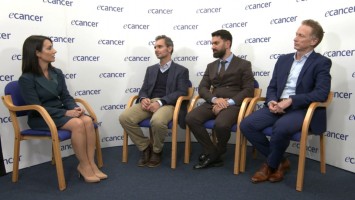
SW: Hello, it’s my great pleasure to welcome you to this ecancer discussion on the latest developments of endometrial cancer with a focus on ESMO 2025. My name is Dr Shannon Westin and I’m a gynaecological oncologist and Professor at the University of Texas MD Anderson Cancer Center in Houston, Texas, in the United States. I am joined by amazing colleagues who are going to help us understand this very important data. So please?
VS: Hello, I am Vanda Salutari, I’m a gynaecological oncologist and I work in Policlinico Gemelli, Rome.
BS: Hi, I’m Dr Brian Slomovitz, I’m a gynaecologic oncologist and the Director of Gynaecological Oncology at Mount Sinai Medical Center in Miami Beach, Florida.
CM: Hello, my name is Christian Marth, I’m a gynae oncologist from the Medical University of Innsbruck in Austria. I’m belonging to AGO Austria and to the ENGOT group.
SW: It’s always so exciting to see my colleagues and friends from all over the world when we come together at ESMO. So let’s get started because we have a lot of great data to get through. Vanda, I want you to talk a little bit about some of the new data that we saw with AtTEnd, both the late breaking abstracts 39 and 40, just digging in on some of the data around atezolizumab in combination with chemo.
VS: Thank you. In this abstract we noticed that in AtTEnd it is confirmed that there is an advantage in overall survival in the dMMR population with a hazard ratio of 0.4. Nevertheless, it is confirmed that the study does not show an improvement in overall survival in the proficient population. So this study is different from the other studies, it is confirming the dMMR population but not in the pMMR population.
SW: We’re not surprised by this, right? We’ve seen this over and over again where if you’ve got the biomarker you get the most benefit from checkpoint. Certainly the fact that we didn’t see progression free survival benefit in AtTEnd, we wouldn’t expect to see an overall survival benefit. Anything surprising from that abstract for you all?
CM: No, not really, but I think the question is what is the reason. Is it the different PD-1, PD-L1 antibody, it’s the population [??]? We know that there were a great amount of Asian population which had a low response to the IO treatment. So I think the question is really open. There is a difference between the trials but still there is a signal in pMMR too, maybe not coming from AtTEnd.
SW: Go ahead Brian.
BS: I agree completely with what’s been said. There are four trials that ran at the same time. It is interesting that some… RUBY did show the overall survival difference, it was suggested overall survival wasn’t the primary outcome so we don’t have all the data from 868 but it was suggested in there. But now we’ve seen the AtTEnd it’s not in the pMMR population but, Shannon, spot on biomarker driven population dMMR it’s a clear survival advantage.
SW: But we still have a pretty reasonable unmet need in dMMR for the population that doesn’t benefit the way that we expect. So the majority of these patients when they have that checkpoint added to chemotherapy do quite well but there’s a proportion of patients in the first year that will have progression of disease despite getting the appropriately targeted therapy. So, Vanda, do you want to talk a little bit about what AtTEnd looked at in that in regards to that?
VS: AtTEnd is very interesting from this point of view because it published very interesting data about biomarkers. So the authors tried to find some biomarker that can predict response or not response to immunotherapy in the MMR population. They found a score, because they noticed that in the dMMR population the aneuploidy correlates with the worst progression free survival and overall survival. So they built a score, the W-AS score, that reflects this aneuploidy and in the MMR population with a high score of W-AS the progression free survival and overall survival are worse. In the molecular biological understanding of this mechanism they found that in this tumour with aneuploidy there is less T-cell infiltrate so maybe there is something in the microenvironment that correlates with the bad response to IO.
SW: And I think it’s really interesting because this is typically such a hot tumour, so responsive to immune checkpoint. But maybe we need to do a deeper dive when we are making these considerations of treatment up front to understand that proportion of patients that might not respond. We did something similar in our abstract which was 1117, looking at DUO-E. So just as a reminder, DUO-E is the combination of both durvalumab with chemo as well as an arm that looked at the combination of durvalumab and olaparib with chemo. We were curious about this population that doesn’t respond with mismatch repair deficient and thought maybe TMB, tumour mutational burden, might have an impact. So we looked to see what the response and benefit of these combinations was in that mismatch repair deficient group, but then also looking at TMB. So the first thing we found was actually really interesting, there’s quite a bit of overlap – almost 70% of the tumours with mismatch repair deficiency had TMB. But when you looked at TMB separately, irrespective of mismatch repair deficiency or not, those patients benefit from the addition of checkpoints. So that made sense. But what I found really interesting is there’s a proportion of patients, about 10%, that are mismatch repair proficient but are TMB high and those seem to really benefit. So that’s pretty exciting. But conversely, we’re still doing an analysis on the TMB low, it doesn’t look like that’s going to be the explanation for those patients that don’t do well. I wondered if there was a group of patients that were mismatch repair deficient but TMB low and they’re the ones who didn’t do well. But we don’t really see that quite yet.
BS: In your pMMR population that were TMB high did you look at POLE mutations, could some of them have been POLE?
SW: It’s very rare in our population. We need to do a deeper dive there but there were only a few percent. We had a really low proportion of patients with POLE [??].
VS: And also in AtTEnd the proportion of POLE was very low, 0.3%. It confirmed that the POLE population usually do not show advanced at this stage. So maybe.
CM: Shannon, did you look also at methylation because I think we are always speaking about the homogeneous mismatch repair deficient but they are not because three quarters of them are mismatch repair deficient not by mutation but by methylation and there is a difference in the methylation profile. The data so far seen from the RUBY trial and also from the [??] trial were not really convincing because the methods used were not very clear. So I think it’s really necessary to do a full methylation analysis. Did you look on this yet?
SW: We are doing a deeper dive there, we don’t have those data as yet. But I agree with you, I think that’s a huge opportunity for a way to potentially predict. Now I’m, of course, circling back with the DUO-E translational scientists trying to find out if we can add aneuploidy as well.
BS: I think this is important because not only in this frontline therapy doing it but the latest trend is talking about IO after IO so maybe some of these biomarkers not only predict first-line response but a subset that could be rechallenged within there.
VS: And another good point will be that biomarkers will driven also when we will have the data of IO versus chemotherapy. So what patients we will candidate to just IO and what patients we will candidate to chemo plus IO in the MMR population. So biomarker, I think it’s really…
SW: It’s going to be important. Not to go too far off the rails with the discussion, but I’m just curious – what do you all think with the B93 and DOMENICA? Do we think we’re going to see benefit or do we think we have the wrong design. I’m very nervous.
CM: It’s the wrong design.
VS: It’s the wrong design.
CM: But of course the trial will be positive. When we looked on LEAP in the mismatch repair deficient trial we saw a hazard ratio of 0.6 comparing chemo versus IO plus a TKI. So I expect that DOMENICA might have almost a similar separation there but what are we doing then?
SW: Yes.
BS: C93, which is the trial that I had the pleasure of helping lead with the GOG, it was the best design at the time.
SW: Right, there’s no judgement here.
BS: But when we look at the data, clearly DOMENICA and C93 they’re going to be active. They’re going to be active but we’re going to be able to then criticise and discuss the control arm.
VS: The control arm is underperforming.
BS: It’s underperforming. There’s going to be a population of patients, however, that would likely benefit from IO alone, we just have to better identify that population.
CM: But maybe we can with the help of artificial intelligence construct an artificial control arm. Because we have now enough data from other trials…
SW: To calculate.
CM: We can extrapolate this data and construct with the patient characteristics a control arm to the experimental arm, maybe that could be possible.
SW: Let’s get back to ESMO, so thank you for allowing me to go off on the rails a little bit there. Brian, I would be really interested, we saw a couple of different abstracts looking at RUBY. Obviously RUBY presented several years ago now but still a lot of opportunity to learn from those patients that were treated. So we saw a little bit about quality of life, we saw a little bit about subsequent therapy, why don’t you go ahead and help us with that?
BS: Thanks. So again it’s the PD-1 dostarlimab with chemotherapy in the frontline setting. Whenever we’re treating these patients when we’re looking at survival we always want to determine whether or not, as you know, crossover makes a difference. So does it matter if you give it in the front line or you can just give it in subsequent lines of therapy? In this meeting there was a very important abstract that showed when you give dostarlimab up front there was a longer overall survival benefit, even when compared to those patients that got checkpoint later on. So it really demonstrates the old saying – the first therapy is the best therapy. Giving dostarlimab up front or a checkpoint up front really yielded a better advantage for those patients, better than saving it for second line. And the interesting thing, another abstract but really related to [??] study in those patients treated with chemotherapy plus dostarlimab there was no change in quality of life when compared to those that didn’t get the dostarlimab. So better overall survival and quality of life, which is tremendously important for us and all of our patients, didn’t get worse.
SW: I love this study because we don’t always… and, again, no judgement, we don’t always do a great job of keeping track about what happens next when we’re designing these large trials. Then we often get this pushback from different providers where they say, ‘Well, I’d rather reserve one of these drugs for later, I don’t want to give all my drugs up front, especially if it isn’t going to yield an overall survival benefit.’ So I was so excited to see these data and see that that collection happened because we can, in the best way possible, get rid of those arguments and say, no, give your patient their best therapy now. They’re going to feel better and they’re going to live longer. Wow, what a great analysis. On that same note I think we also saw some really great re-analysis of lenvatinib and pembrolizumab and looking at some of the data around sequencing that therapy. So, Christian, do you want to talk a little bit about what was presented?
CM: Yes, I was really excited about the data because we know that endometrial cancer is different than ovarian cancer. Rechallenging endometrial cancer with platinum-based therapy results in a poor outcome, it’s not like ovary where we can re-treat and treat. That's not the case in endometrial cancer and we have now data from the KEYNOTE-775 in which patients have been included following neoadjuvant or adjuvant chemotherapy and also in our LEAP trial also 120 patients were included following neoadjuvant and adjuvant chemotherapy and they had no other chemo later. When we look on the PFS and overall survival we see great outcomes. So there’s a hazard ratio of 0.6 for both trials so lenvatinib + pembrolizumab is working in those pre-treated population although it’s not considered as the standard treatment option. But we know that we also have a label because we have a label for all patients following a line of chemotherapy and adjuvant and neoadjuvant is such a kind of line of treatment. We saw better overall survival, we saw better progression free survival, a higher response rate, a longer duration of response. So there are two different trials demonstrating the same. So I think that’s really an option for patients following the neoadjuvant/adjuvant therapy be treated with lenvatinib + pembrolizumab instead of re-challenging with carboplatin + paclitaxel. The guidelines, the European ESGO ESTRO ESP guideline, also included this as a possible option.
VS: Can I add that in the abstract there is a real life of pembrolizumab + lenvatinib that is clearly showing that platinum-free interval cannot be applied to endometrial cancer because the combination showed higher benefit also in patients that relapse after 12 months. So I think that it’s a completely different disease and we must consider biology and not the platinum free interval.
SW: It was a really exciting meeting for that reason because we have been treating advanced endometrial cancer the same way as ovarian, we’ve been lumping it, we’ve been assuming. So to get these data to say no, let’s move away from platinum-based therapy and instead go to a very active combination, that makes it really exciting.
BS: And one of the things that makes it more exciting, unfortunately the B21, the adjuvant use of IO, didn’t work. So we’re definitely not using IO in this adjuvant setting. We always want to give our patients a new option. Even though LEAP was a negative trial, when you look at the curves there is still activity. But now with the data that you really led it’s really exciting. In my clinic I’m giving it for my patients. The other party that’s not here are our patients, giving them a chemo-free option is tremendous and that’s what they’re saying with the lenvatinib + pembrolizumab.
SW: I do think it’s important to note, though, that these patients wouldn’t be patients that got chemotherapy with checkpoint in that up front setting, just to your point. So we still don’t know the IO after IO question and that’s where the remainder of what we’re going to talk about today gets more exciting. So some of the antibody-drug conjugates, some of the novel therapies, what are we going to do in that patient population that gets chemo and checkpoint and has progression of disease. So, Christian, why don’t you talk a little bit about the Rina-S data that was…
CM: Yes, I’m already happy because I saw the poster, it’s amazing data. 60 patients have been enrolled in the trial with the ADC Rina-S against folate receptor alpha. We saw 50% response in those patients.
SW: Incredible.
CM: That’s incredible. The waterfall plot was amazing and I think the most important point was that the responses were seen irrespective of the folate receptor alpha expression. So that’s really new, that’s the new development, the new ADCs are targeting better the cell because they are recognising better even low levels of the target and are able to deliver this type of payload. So I think that’s really amazing, so antibody-drug conjugates are really the future and it’s not the end of the story because what we know is that these ADCs are using the immunological cycle and lot of damage associated molecules are coming out, stimulating dendritic cells and activating the T-cells but if the T-cells cannot work because there is a block of the high expression of PD-1 then it doesn’t work and therefore a combination of checkpoint inhibitor with ADCs is really something which is the future. We know trials are ongoing really asking this very important question.
SW: Yes, and just like any drug development when we like something second, third, fourth line, we’re going to push it earlier. I’d love to get a sense of some of the other targets that you all are excited about. What are some of the other antibody-drug conjugates that you’re fired up to see the data on?
BS: I think Christian mentioned new ADCs, I think all the ADCs. So it’s going to be tough to compare and contrast. The standard right now is trastuzumab deruxtecan, we have regulatory approval in the US for use in the second line. You were just saying we try and move things earlier and earlier – there’s one study that was presented here as a trial in progress, it’s looking at in patients that have HER2 overexpression, 2+ or 3+, integrating trastuzumab deruxtecan with pembrolizumab versus standard of care chemotherapy with pembrolizumab and there’s actually a third arm looking at a novel bispecific with the trastuzumab deruxtecan, that’s what we call the DESTINY-01 trial. Also in the first line we’ve had a lot of good second line experience with the TROP2 ADCs and at this meeting there was a trial in progress which was Trofuse-033, which is GOG3119, looking at adding TROP2 ADCs in the maintenance setting. So it’s really exciting as we see this great demonstrated activity in second and third line moving up to earlier lines of therapy.
VS: And lastly corticosteroids receptor inhibitor - relacorilant is starting an expansion group in the BELLA trial in which we will explore the nab-paclitaxel with relacorilant in endometrial cancer. It sounds very good from a rationale point of view because endometrial cancer patients have a metabolic syndrome so cortisol is very high in these kinds of patients.
BS: [??] look at that as it opens up. To your point, we don’t know IO after IO yet. We definitely don’t know ADC after ADC yet, particularly with the same payload. So I’m excited about the relacorilant. I’ve always been a big advocate, Shannon as you have, about the biomarker driven hormonal therapies. There was some really good data presented at this meeting with nab-sirolimus – 44% response rate in endometrial cancer patients. There’s a theme here – getting rid of chemo, getting rid of chemotherapy. How cool would it be if we could start eliminating toxic chemotherapy for some of our patients.
SW: Brian, you were so early in the exploration of the mTOR PI3 kinase pathway with arguably drugs that maybe aren’t as good as the ones we have access to now. So I’m glad that we haven’t completely given up that particular target because I do think with some of these newer drugs that we can hit the target better, that we have better affinity or that we’re hitting multiple points along the pathway that we have the potential to see, realise the goals that we had back 15, 20 years ago. Was that too aggressive? But I also think there’s a few other ADC targets that are really interesting. So I think certainly the B7-H4, CDH6, those are opportunities that are potentially going to be utilised in endometrial cancer. But, again, if they’ve already gotten trastuzumab deruxtecan, if they’ve already gotten a TROP2 will they be… So there’s so much we don’t know.
CM: That’s an important question. The sequence of ADCs will be really a major point. So when we look on the data we have so far with the ADCs which are available, only 12% of the patients don’t have any target but many have more targets. So then you can think about sequencing but the question is how do we sequence then the payload? The next point is can we use the same target but change the payload? There are two different issues. From breast cancer we have learnt that there might be some problems by sequencing trastuzumab deruxtecan and [??]. There’s an issue you will have in the next line a lower response, well I think that is something we don’t have any data on in endometrial cancer so far.
SW: So hopefully we’ll see that in the next few ESMOs. I just want to thank my colleagues for this lively discussion and thank all of you for joining us at this ecancer discussion on the latest developments in endometrial cancer. Have an awesome day.